Why no line in Brewpire is straight
Until now it’s mostly been Jannik writing here – about timers, about the floor and the ceiling, about everything you can explain in numbers. Today it’s my turn for once. Because everything you see in Brewpire is made by hand: every cup, every windowsill, every crease in Nomi’s apron. And the most important rule behind it sounds odd at first – here, nothing is straight on purpose.
The first shop was too pretty
My very first version of Grandma’s café was tidy. Clean edges, straight shelves, even lighting. It looked like something out of a catalogue – and that was exactly the problem. It felt like a furniture showroom, not a place where coffee has been brewed for thirty years.
So I started breaking everything again, just a little. The counter got a dent where a thousand cups have been set down. A shelf hangs ever so slightly crooked. The wallpaper has faded in one corner, because the afternoon sun hits it there every day.
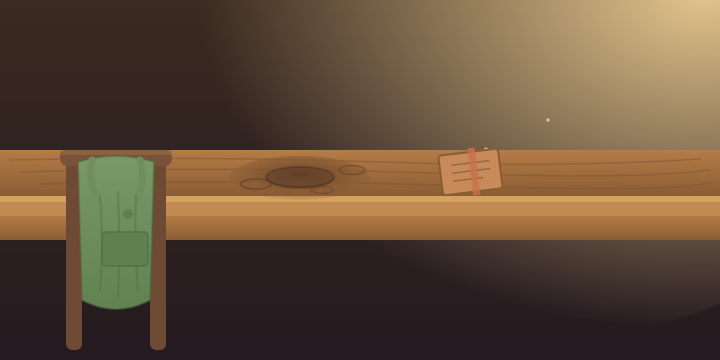
A perfect room looks new. A warm room looks used.
Hand-painted means you can see the hand
I don’t draw on a drafting board, but with a pen straight onto the display, stroke by stroke. Which means no two lines are exactly the same. The window on the left is a hair different from the one on the right. And that’s deliberate. The moment something is perfectly mirrored or exactly repeated, the eye instantly registers “computer” – even if you couldn’t say why.
The longest I spend, by the way, isn’t on the big things but on the small ones: the steam above the cup, the stain on Jonas’s hood, the one tile that doesn’t quite fit. Nobody looks at them on purpose. But together they add up to the feeling that someone lives here.
Light is half the story
The thing I’m most attached to is the light. The shop follows the real time of day, after all – the cool coffee rush in the morning, that golden window in the afternoon, warm and dimmed in the evening. For each time of day I paint its own mood. The same café feels different at eight in the morning than at eight at night, without a single piece of furniture moving.
The golden afternoon is my favourite. It’s exactly the hour when you most want to come in, sit down and do nothing at all.
I don’t paint rooms. I paint times of day that happen to have a café in them.
Mitsu gets the most care
And yes – Mitsu the cat costs me more time than any other character, even though she does absolutely nothing in gameplay terms. But she’s the heart of every frame. The way she lies, the way her tail twitches, the way she almost melts in the sun: if Mitsu feels cosy, the whole shop feels cosy. She’s my litmus test. If Mitsu looks content, the picture is finished.
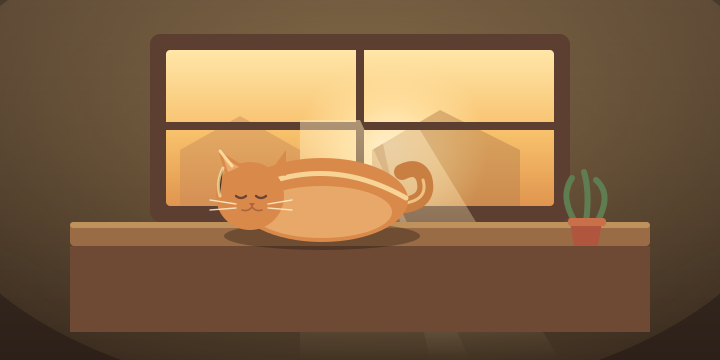
If you open Brewpire later and think, just for a moment, “I’d like to sit here” – then the crooked lines did their job. That’s exactly why I make them crooked.
— Annalena